What The Tech: Fake AI videos are circulating ahead of the midterms
BY JAMEY TUCKER, Consumer Tech Reporter
Artificial intelligence can make celebrities and politicians appear to say things they never
said. With the midterm elections approaching, experts warn that convincing deepfakes
could make it harder for voters to separate fact from fiction.
Is that video real, or was it created using artificial intelligence?
Not long ago, spotting a fake video or image was relatively easy. There might be something
wrong with a person’s hands, unnatural facial movements, or a voice that didn’t quite sound
right.
But AI technology has improved dramatically. Today, even convincing-looking videos of
celebrities can be completely fabricated.
And with Election Day approaching, the consequences go beyond online scams.
A Fake Jaden Smith Video Shows How Convincing AI Has Become Researchers at Graphika, a company that investigates online threats and misinformation, discovered a series of social media accounts sharing a video of actor and rapper Jaden Smith.
In the video, Smith appears to be speaking Spanish and promoting giveaways involving major
American banks, including Chase and Wells Fargo.
There’s just one problem. Smith never said any of it.
The video was created using artificial intelligence to make it appear that Smith was delivering
the message.
“This is pretty decent quality video. The audio is pretty good,” said Tyler Williams, vice president
of intelligence at Graphika.
Graphika identified nearly 30 accounts sharing the same video. Researchers believe the goal
was to trick people into visiting a website and entering their online banking login information.
Williams said Graphika’s native Spanish-speaking employees found the audio convincing.
What makes the scam particularly troubling is how little effort may have been required to create
it. The people behind the video didn’t need Smith to participate. They could use existing footage
of him available online.
What Happens When Deepfakes Target Political Candidates?
The same technology used to impersonate a celebrity can also make a political candidate
appear to say or do something that never happened.
That’s a particular concern with the November 3 midterm elections approaching.
A fabricated video could show a candidate making an inflammatory statement, endorsing a
position they don’t support, or behaving in a way that could influence voters.
But Williams says a fake doesn’t necessarily have to be convincing to spread.
People sometimes share AI-generated images and videos even when they suspect the content
isn’t real, simply because they agree with the message.
“Yeah, I know that that’s fake. Like this image has 10 fingers on one hand, but like I feel like
that. So I’m going to share that,” Williams said, describing how some social media users react to
fabricated content.
That willingness to share something because it reinforces an existing opinion can help
misinformation reach thousands or even millions of people.
Millions Being Spent on Political Ads Using AI
Artificial intelligence is already playing a role in political advertising.
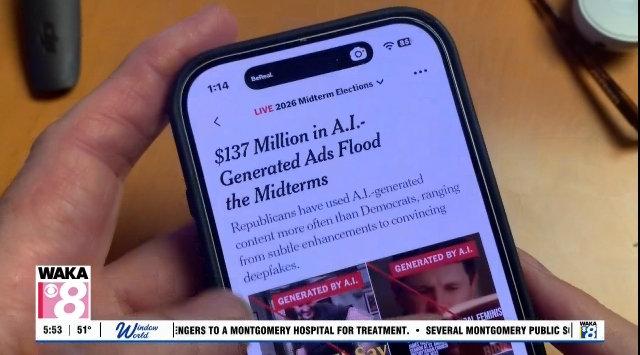
According to research by the Wesleyan Media Project reported by The New York Times, more
than $137 million was spent airing political advertisements created at least partly with artificial
intelligence. Researchers identified more than 220 such ads.
Not all AI-assisted political advertising is deceptive. The technology can also be used for
ordinary production tasks. But some ads use fabricated images, voices, or video to portray
political figures in ways that aren’t authentic.
‘One example involves an AI-generated depiction of New York political figures Kathy Hochul and
Zohran Mamdani walking through the park. The video is much higher quality that AI-generated
videos we’ve seen in the past.
The growing use of AI in political messaging raises questions about whether viewers can
recognize manipulated material, particularly when watching videos quickly on social media.
How to Protect Yourself From AI Deepfakes
Williams says the best defense isn’t necessarily learning to recognize every technical flaw in an
AI-generated video.
Instead, it’s questioning the source.
He tells students in his intelligence courses to “interrogate your source of data.”
Before believing or sharing a shocking video, consider who posted it and why. Look for the
original recording, check whether reputable news organizations have verified the claim, and be
especially suspicious of videos designed to provoke an immediate emotional reaction.
A celebrity offering free money or a politician making an outrageous statement should be a
reason to investigate, not immediately share.
And don’t assume that because a video looks and sounds authentic, it must be real.
Are Political Deepfakes Legal?
There is currently no comprehensive federal law specifically regulating AI-generated political
advertising.
However, 31 states have enacted laws addressing the use of AI or deepfakes in political
messaging. Some require disclosures identifying AI-generated content, while others restrict
certain deceptive uses of the technology.
Those rules vary by state.
For voters, the most important takeaway is simple: Before you believe what you see online,
verify where it came from.
Artificial intelligence has made it easier than ever to manufacture a convincing video. That
means seeing something with your own eyes is no longer proof that it actually happened.